Albania
 Argentina
 Australia
 Austria
 Belgium
 Bosnia and Herzegovina
 Brazil
 Bulgaria
 Canada
 Chile
 Colombia
 Croatia
 Czech Republic
 Denmark
 Estonia
 Finland
 France
 Germany
 Greece
 Hungary
 Ireland
 Italy
 Latvia
 Lithuania
 Luxembourg
 Mexico
 Moldova
 Montenegro
 Netherlands
 New Zealand
 North Macedonia
 Norway
 Philippines
 Poland
 Portugal
 Romania
 Serbia
 Slovakia
 Slovenia
 South Africa
 Spain
 Sweden
 Switzerland
 Turkey
 Ukraine
 United Kingdom
 United States of America


Wireless and portable speakers
A wireless portable speaker plays music from your phone or another compatible source without a permanent audio cable. A small model can fit in a backpack or sit on a desk, while a larger speaker can fill a garden get-together or a house party. The differences aren't only about volume: battery life, durability, dimensions, charging and connectivity options all matter. Choose based on where you'll use it, not on the highest wattage figure.
How to choose a Bluetooth speaker
For everyday carrying, pay attention to weight, dimensions and a shape that fits safely in a backpack. For a terrace or holiday, a rated water and dust resistance is useful, but always within the range stated by the manufacturer. For a larger room or a party you need more volume headroom and a stable placement. In every scenario, check the charging method and the real-world mode in which you'll be using the speaker.
Battery life and charging
Battery life depends on volume, light effects, temperature and use of additional features. Treat the manufacturer's figure as a reference point, not a guarantee of the same runtime every time. USB-C makes sharing a charger with other devices easier, but the connector type doesn't tell you anything about charging speed. If you'll be away from a socket for a long time, a clear battery level indicator is helpful.
Resistance doesn't mean indestructibility
An IP rating describes a specific level of protection against dust or water. A splash-proof speaker isn't necessarily designed for submersion, and the protection may only apply when connector covers are properly closed. After contact with salt or chlorinated water, follow the manufacturer's instructions. Sand, impacts and low temperatures may be subject to different limitations.
Compact speaker or partybox?
| Type | Main advantage | Typical use |
|---|---|---|
| Small portable speaker | Low weight and easy packing | Bedroom, trip, desk |
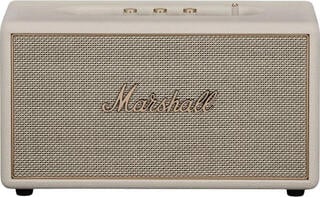
| Medium-sized Bluetooth speaker | Balance of portability and volume | Terrace, picnic, small gathering |
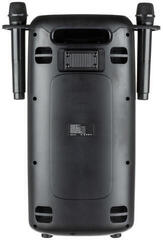
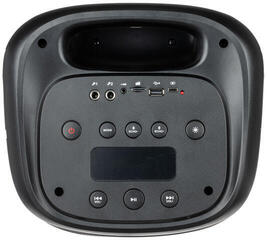
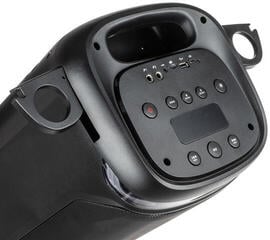
| Partybox | Higher volume headroom and extra features | Party or larger space |
| Speaker with radio | Listen to stations without a phone | Cabin, workshop, kitchen |
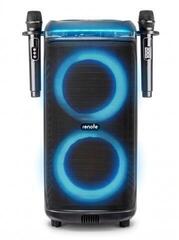
If low weight is your top priority, go straight to portable speakers. For sound at parties along with features such as light effects or microphone inputs on selected models, take a look at partyboxes. If you don't want to rely solely on content stored on your phone, compare Bluetooth speakers with radio.
Connectivity and playback from multiple sources
Bluetooth is the foundation, but individual models may also offer an analogue input, USB playback, a memory card or radio. Don't confuse a USB port for charging with one for playing back files. If you want to link two or more speakers together, check that those specific devices support the same pairing function; the mere presence of Bluetooth isn't enough. For video, audio latency may also matter.
Sound indoors and outdoors
Indoors, walls and corners boost the bass, sometimes excessively. Outdoors the sound has nothing to reflect off, so the same speaker sounds less full. A model that projects sound in multiple directions works well in the middle of a group; classic front-facing radiation can be aimed directly at the listeners. Don't place the speaker on an unstable or wet surface, and keep its drivers and passive radiators unobstructed.
Accessories and carrying
A case protects the device in luggage, a mount or strap can make carrying easier, and the right charging cable helps on the road. Dimensions and attachment points must match the specific model, so a generic label isn't enough. Look for compatible options among portable speaker accessories. More devices for listening away from your home setup can be found in the portable audio category.
Choose by specific scenario
For the desk and kitchen
In a smaller room you'll appreciate simple controls, a stable footprint and sound that stays intelligible even at low volume. A large battery and maximum loudness may not be decisive if a socket is nearby. Automatic connection to your phone and buttons accessible without an app may matter more. In the kitchen, keep a safe distance from water, steam and hot surfaces, even if the manufacturer states a certain protection rating.
For hiking and day trips
Every gram you carry adds up alongside the rest of your gear, so compare weight against the real-world gain in volume. A carry loop or fixed attachment point is only practical if it's designed for the way you plan to carry it. Keep the speaker in your backpack so that buttons don't get pressed and connectors don't get damaged. In nature, use an appropriate volume level and be considerate of people and animals nearby.
For the terrace, garden and picnics
Outdoors, sound disperses faster than indoors, so group size and speaker orientation matter. Position it higher than ground level and don't hide it behind bags or furniture. Water resistance helps only with accidental splashing within its specific certification; it's not permission to leave the device out in the rain. Also check the range from your phone so the connection doesn't drop as guests move around.
For a house party
With a larger group, volume headroom, stability and easy access to the controls are important. Light effects or a microphone input are only useful if you'll actually use them. A larger model tends to be heavier and needs a considered placement away from the main route guests will take. If it stays near a socket, you don't need to prioritise battery capacity over other features.
One speaker, a stereo pair or a linked group
A single portable speaker is the easiest to carry and get going quickly. Two compatible models can form a left and right channel or play together in a larger space, but the way they link is determined by the manufacturer. The same brand and the same Bluetooth version don't automatically guarantee joint playback. If you plan to buy the second unit later, check the exact designation of supported models and whether the feature works without an internet connection.
| Setup | Benefit | Limitation |
|---|---|---|
| Single speaker | Easiest to carry and control | Sound comes from one point |
| Stereo pair | Separate left and right channels | Requires supported pairing of specific models |
| Group playback | Coverage of a wider area | Doesn't necessarily mean true stereo |
Phone calls, powerbank and other features
A built-in microphone allows you to take calls on selected models, but the result depends on the distance and surrounding noise. The powerbank function can top up your phone, but it also shortens the remaining playback time. A voice assistant often requires a phone and the relevant permissions. Judge features by what you'll actually use regularly; every additional item on the list can mean more complex controls or higher power consumption.
Looking after the battery and connectors
Don't charge the speaker when it's wet, and let the connector dry before plugging in a cable, following the manufacturer's guidance. Long-term storage in a hot car or in freezing conditions isn't good for the battery. If you're not using the device for a while, check the charge level occasionally and follow the recommendations in the manual. Don't use a damaged cable or a loose connector just because it still charges occasionally.
After returning from a dusty environment, clean the surface with a soft dry cloth or one that is slightly damp, as directed in the manual. Don't insert objects into the grille, and keep connectors closed if they have protective covers. A case protects during transport, but don't leave a wet speaker sealed inside it. Let it dry in a well-ventilated spot before storing.
What to check before ordering
- dimensions and weight including the way it's carried,
- battery life for the features you plan to use,
- the exact protection rating and its conditions,
- inputs, charging connector and supported audio sources,
- compatibility when pairing multiple speakers.