Albania
 Argentina
 Australia
 Austria
 Belgium
 Bosnia and Herzegovina
 Brazil
 Bulgaria
 Canada
 Chile
 Colombia
 Croatia
 Czech Republic
 Denmark
 Estonia
 Finland
 France
 Germany
 Greece
 Hungary
 Ireland
 Italy
 Latvia
 Lithuania
 Luxembourg
 Mexico
 Moldova
 Montenegro
 Netherlands
 New Zealand
 North Macedonia
 Norway
 Philippines
 Poland
 Portugal
 Romania
 Serbia
 Slovakia
 Slovenia
 South Africa
 Spain
 Sweden
 Switzerland
 Turkey
 Ukraine
 United Kingdom
 United States of America


Megaphones
A megaphone amplifies spoken instructions wherever you need to address a group quickly without setting up a complete PA system. It is useful for sports training, event organisation, outdoor teaching, marches and directing people around a site. When choosing, consider the power supply, weight, controls and speech functions rather than the power rating alone. Also consider how long you will be holding it and the environment in which it will operate.
When a megaphone makes sense
Its key advantage is immediate readiness. You do not need to set up stands, run signal cables or adjust a mixing console. This makes it more practical than a conventional speaker for brief organisational instructions. If you want to play music, use several microphones or provide even coverage for an audience during a longer programme, a PA system will be more suitable.
A megaphone projects the voice into a relatively narrow area. This helps when communicating with people in front of you, but it does not provide even coverage of a crowd in every direction. Move it slowly as you speak to match the distribution of listeners, and do not stand too close to the person at whom the sound is directed.
Comparison of common designs
| Type | Suitable use | Practical compromise |
|---|---|---|
| Compact handheld | Training, smaller groups, brief instructions | Easier to carry, generally less space for controls and the power source |
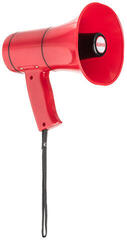
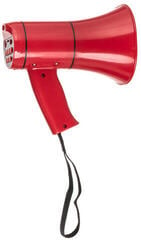
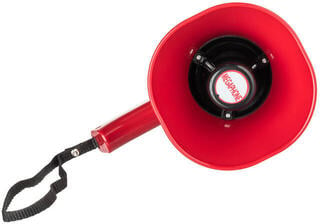
| Larger handheld model with strap | Organising an event or moving around a site | Better weight distribution, but you still have to carry it |
| With a separate microphone | Longer announcements from one location | More comfortable microphone handling; the megaphone body must be placed or hung securely |
| With recording playback | Repeated announcements and signals | Saves your voice, but check the recording and playback procedure in advance |
Power and real-world operation
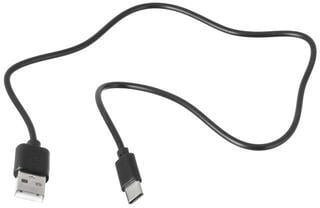
A model may use replaceable batteries or a rechargeable battery. The first option lets you insert a prepared spare set, while the second reduces the need to buy disposable cells. With a rechargeable battery, check the charging method and charge it before the event; with replaceable batteries, check the type, quantity and correct polarity. Volume, the siren and temperature all affect the stated operating time, so keep a reserve.
- For regular duty, establish a routine for checking the power supply.
- Carry spare batteries so their contacts cannot short-circuit.
- If the megaphone is not used for a long time, follow the manufacturer's instructions for storing its power source.
- Test the device at the venue and with the expected level of ambient noise before the event.
Functions with a specific purpose
Siren and warning tone
An audible signal attracts attention faster than a sentence, but use it with care. It can be unpleasant at close range and unsuitable at some events. Check that the button cannot be pressed accidentally while carrying the unit.
Recording and playback
A short recording is useful when you repeat the same instruction. Check its duration, deletion method and whether the recording remains stored after changing the batteries. This function is not a substitute for a speaker system for a music programme; its purpose is to deliver an intelligible announcement.
Separate microphone and volume control
A wired microphone can reduce strain on your arm because you can hang the megaphone body from your shoulder. Check the cable length and routing so it does not catch on anything. Start with the volume low and increase it to the required level. When the microphone is positioned correctly near your mouth, you do not need to shout or run the device at full volume.
Handling, weather and intelligibility
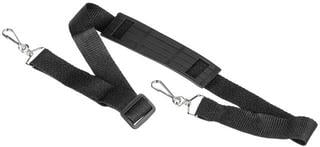
An organiser, teacher or coach may carry a megaphone on their shoulder for hours, so its weight becomes more noticeable than during a brief announcement. Consider the handle, strap and control layout. The enclosure material alone does not confirm resistance to rain. If the manufacturer does not specify suitable protection, keep the device away from water and let it dry after use as instructed.
Intelligibility does not come from volume alone. Speak slowly, use short sentences and pause between instructions. Do not point the horn at a hard wall from close range, as reflections can make speech less clear. For a larger area, move around or ask another person to help instead of raising the level from a single position.
Megaphone or portable speaker?
For a station supervisor, referee or guide, a megaphone is straightforward: pick it up and speak immediately. A portable battery-powered speaker is more suitable when you need music, a microphone input or a longer programme from one location. For temporary coverage of a larger area, also consider a complete PA system. Decide according to the programme and whether you will move among people with the equipment or speak from one place.
Checklist before use
- Insert or charge the power source and perform a voice test.
- Adjust the strap so the megaphone does not strike your body while walking.
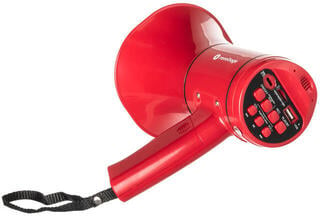
- Check the talk, siren and recording buttons.
- Determine the direction from which you will speak and a safe distance from listeners.
- After the event, switch off, clean and store the device in a dry place.