Albania
 Argentina
 Australia
 Austria
 Belgium
 Bosnia and Herzegovina
 Brazil
 Bulgaria
 Canada
 Chile
 Colombia
 Croatia
 Czech Republic
 Denmark
 Estonia
 Finland
 France
 Germany
 Greece
 Hungary
 Ireland
 Italy
 Latvia
 Lithuania
 Luxembourg
 Mexico
 Moldova
 Montenegro
 Netherlands
 New Zealand
 North Macedonia
 Norway
 Philippines
 Poland
 Portugal
 Romania
 Serbia
 Slovakia
 Slovenia
 South Africa
 Spain
 Sweden
 Switzerland
 Turkey
 Ukraine
 United Kingdom
 United States of America



Tweeters
A tweeter, or high-frequency driver, reproduces the upper part of the audio spectrum in a loudspeaker system. It works with the midrange and woofer through a crossover that divides the signal into the relevant bands. It is used in home hi-fi, studio, sound-reinforcement and other loudspeaker systems, but a replacement part must match the particular design electrically and mechanically. When choosing, diaphragm diameter or the appearance of the faceplate is not enough; check impedance, sensitivity, operating range, power handling and recommended crossover point according to documentation.
The role of the high-frequency driver
A tweeter processes details you perceive in music, for example in cymbals, vocal sibilance, strings or the attack of many instruments. However, it is not intended to reproduce the entire range. If you send it too many low frequencies or an unsuitable level, it can be damaged. A correctly designed crossover provides protection and integration with the other drivers.
The result is not determined by the tweeter alone. It is affected by the cabinet, driver placement, crossover, directionality, amplifier and room acoustics. Replacing it with an allegedly better part without redesign may change frequency response and crossover loading, even if the new part physically fits the opening.
Comparison of common designs
| Design | Design characteristic | When choosing, consider |
|---|---|---|
| Dome tweeter | Dome-shaped diaphragm, common in hi-fi and monitors | Material, mounting opening, impedance and crossover |
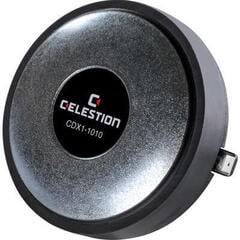
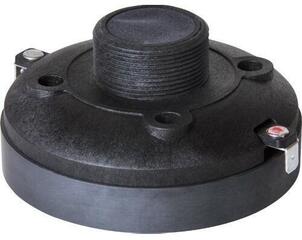
| Compression driver with horn | A smaller diaphragm feeds a waveguide for sound-reinforcement use | Throat type, waveguide, recommended range and protection |
| Ribbon or planar type | A different light-diaphragm principle | Specific sensitivity, directionality and crossover requirements |
| Replacement diaphragm or voice coil | A service part for a specified driver model | Exact compatibility designation and installation procedure |
If you are not repairing only the high-frequency section, you can find other types among midrange speakers and woofer speakers and subwoofers. Plan the entire repair as an intervention in one loudspeaker system, not as three independent purchases.
Electrical compatibility
Impedance
The nominal impedance of a replacement driver must match the crossover and loudspeaker system design. Changing impedance shifts filter behaviour and can improperly load the amplifier or the tweeter itself. Do not estimate it from size. Look for the service designation of the original part, a schematic or manufacturer confirmation.
Sensitivity and level
If the new tweeter has different sensitivity, the highs may be too loud or too subdued relative to the rest of the system. The level is sometimes adjusted in the design with a resistor network, but such a change must be calculated and verified by measurement. Adding a component at random can alter both impedance and crossover response.
Power handling and operating range
A numerical power-handling figure cannot be compared without the measurement conditions and crossover frequency. The tweeter is protected by a suitable filter and its slope. A part with a higher number may not survive in a system with an unsuitable crossover. Follow the manufacturer's recommendations and design headroom across the whole system.
Mechanical dimensions and directionality
Measure the outside dimension, mounting opening, depth, screw spacing and, with a compression driver, the type of waveguide connection. Also check the space behind the faceplate. The seal must fit closely and screws must be tightened evenly so the frame does not warp. Keep metal filings and tools away from the magnetic system.
Directional characteristics are affected by the shape of the front and waveguide. In a finished loudspeaker system, tweeter position is designed in relation to the other drivers. Rotating a waveguide or changing its type can alter coverage. In a PA application, therefore, do not regard a driver and horn as arbitrarily combinable parts.
Diagnosis first, then replacement
- Disconnect the amplifier and power to the active loudspeaker system, and leave service tasks to a qualified person.
- Record the original driver's designation and photograph the polarity of the wires before removal.
- Check the crossover; non-functioning highs do not always mean a damaged tweeter.
- Verify the exact replacement part, not merely a similar commercial name.
- After repair, start testing at a low level and compare both sides of the stereo pair.
In the loudspeaker spare parts category, you will find other service components as well. In an active loudspeaker system, the cause may be the amplifier module or protection circuit; do not replace parts by trial and error without diagnosis.
For your own build, measurement is essential
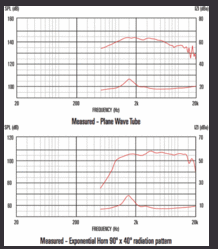
When building your own loudspeaker system, you need data on individual drivers, a cabinet and crossover design, and measurement of the result. A catalogue frequency curve is usually obtained under specified conditions, and behaviour changes after fitting it to your own baffle. Simulation is a good start, but verify the prototype with electrical and acoustic measurement.
Dividing the system into a tweeter, midrange and woofer allows each to work in a more suitable range, preserving the original idea of the category. The resulting integration is not automatic, however. Crossover frequencies, phase and levels must meet in the listening direction without pronounced gaps or overlap.
Check before ordering
- Find the exact model or service designation of the original part.
- Compare impedance, sensitivity, recommended range and power-handling conditions.
- Measure the mounting opening, depth and fixing spacing.
- Verify compatibility with the crossover or specified processor setting.
- For a compression driver, check the waveguide and throat type.
- If data is missing, contact service rather than choosing by appearance.
The correct tweeter restores the high-frequency branch without disturbing its relationship with the other drivers. A matching service part brings the least uncertainty. For a substitute, compare electrical, acoustic and mechanical parameters.