Albania
 Argentina
 Australia
 Austria
 Belgium
 Bosnia and Herzegovina
 Brazil
 Bulgaria
 Canada
 Chile
 Colombia
 Croatia
 Czech Republic
 Denmark
 Estonia
 Finland
 France
 Germany
 Greece
 Hungary
 Ireland
 Italy
 Latvia
 Lithuania
 Luxembourg
 Mexico
 Moldova
 Montenegro
 Netherlands
 New Zealand
 North Macedonia
 Norway
 Philippines
 Poland
 Portugal
 Romania
 Serbia
 Slovakia
 Slovenia
 South Africa
 Spain
 Sweden
 Switzerland
 Turkey
 Ukraine
 United Kingdom
 United States of America



Hi-Fi Subwoofer cables
A Hi-Fi subwoofer cable carries a line-level signal from the output of an amplifier, AV receiver, or preamplifier to an active subwoofer. Before choosing one, check the connectors on both devices, the required length, and the cable’s entire route. It is not a speaker cable intended to connect a power output to a passive speaker. The actual inputs, outputs, and manufacturers’ instructions for your system are therefore what matters.
Hi-Fi subwoofer cables and the signal path
The signal travels from the audio source to the amplifier, receiver, or preamplifier, and from there through a SUB OUT, LFE OUT, or suitable PRE OUT to the line input of the active subwoofer. The subwoofer has its own amplifier, so it normally receives a line-level signal rather than a speaker-level signal at this stage.
Home cinema systems often use a single connection from the SUB/LFE output to an LFE, MONO, or LINE IN input. A stereo system may have a dedicated subwoofer output or left and right pre-outs. If the subwoofer offers multiple inputs, you do not have to connect them all; when there is only one output, use the input specified by the manufacturer for a mono or LFE connection.
Connectors at both ends
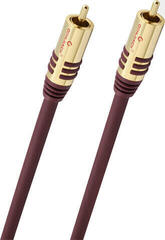
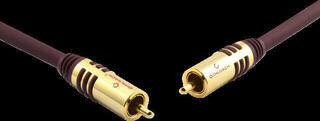
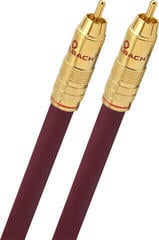
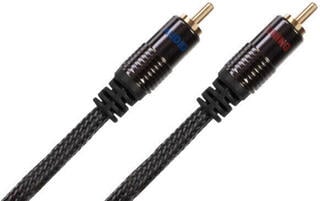
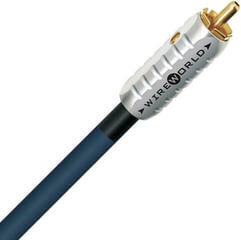
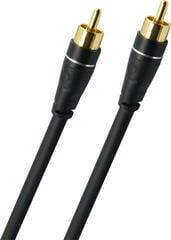
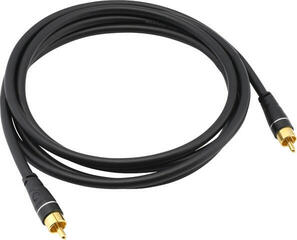
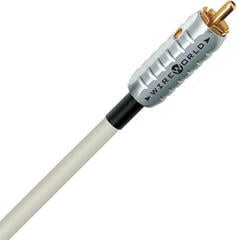
The most common option is a cable with one RCA connector at each end. The socket’s colour does not determine its function, so check the label next to the connector. Use a pair of RCA cables only in a system with corresponding left and right outputs and inputs. A Y cable is not a universal substitute for a missing output and should only be used in a connection permitted by the device documentation.
Some components use a balanced XLR connection. Choose an XLR cable when both ends support this type of line-level connection. A simple adapter between different connectors does not by itself confirm suitable electrical wiring or signal level.
| Connection | Source output | Subwoofer input | Cable |
|---|---|---|---|
| SUB/LFE | SUB OUT or LFE OUT | LFE, MONO, or designated LINE IN | RCA to RCA |
| Stereo line-level | Left and right PRE OUT | Left and right LINE IN | Pair of RCA cables |
| Balanced line-level | Compatible XLR output | Compatible XLR input | XLR to XLR |
| Speaker level | Power output | Explicitly labelled high-level input | Not a standard RCA subwoofer cable |
Cable length and routing
Measure the length along the actual route beside walls or furniture, not just the direct distance between the devices. Allow for going around obstacles, vertical sections, and reasonable slack for moving components. The cable should not be taut or sharply bent immediately behind the connector.
Route it away from places where it could be pinched, pass over a sharp edge, or be stepped on. Do not run the subwoofer cable parallel to power wiring for an unnecessarily long distance, but do not regard its route as a guarantee that interference will be eliminated. For trunking or a cable opening, also check the dimensions of the fitted connector, not only the cable diameter.
Checklist before choosing
- Find the exact output that will carry the signal.
- Check the input label on the active subwoofer.
- Check the number and type of connectors on both sides.
- Consult the manuals to find out which input is intended for a single-cable connection.
- Use a Y cable or adapter only for an explicitly supported connection.
- Measure the entire route, including slack and the space behind the devices.
- Check that trunking and openings can also accommodate the connector.
- Make sure the cable will not be compressed or mechanically stressed.
- Connect the system temporarily and test it before installing the cable permanently.
Subwoofer and speaker cables are not the same
A speaker cable carries a speaker-level signal from an amplifier to a passive speaker. A standard RCA or XLR subwoofer cable carries a line-level signal to an active subwoofer with its own amplifier, so do not interchange them arbitrarily.
The exception is a subwoofer with explicitly labelled high-level inputs. This type of connection must follow the instructions for both the subwoofer and amplifier and does not use a standard RCA cable as a substitute for speaker wiring. If the amplifier does not have a SUB OUT, do not assume that any adapter will create a suitable line output.
When building your system, you can look for related components in the Hi-Fi systems category, but always compare the specific inputs and outputs. After connecting everything, check the selected output, the correct input, that the connectors are fully inserted, and the subwoofer settings on the source device.