Albania
 Argentina
 Australia
 Austria
 Belgium
 Bosnia and Herzegovina
 Brazil
 Bulgaria
 Canada
 Chile
 Colombia
 Croatia
 Czech Republic
 Denmark
 Estonia
 Finland
 France
 Germany
 Greece
 Hungary
 Ireland
 Italy
 Latvia
 Lithuania
 Luxembourg
 Mexico
 Moldova
 Montenegro
 Netherlands
 New Zealand
 North Macedonia
 Norway
 Philippines
 Poland
 Portugal
 Romania
 Serbia
 Slovakia
 Slovenia
 South Africa
 Spain
 Sweden
 Switzerland
 Turkey
 Ukraine
 United Kingdom
 United States of America



9V Baterries
9V batteries have a typical rectangular shape with two terminals on top, but individual products may differ in chemistry, voltage, rechargeability, and performance in a particular device. When choosing one, do not rely only on its appearance or the “9V” label. Always compare the information on the original battery, in the device manual, and on the packaging of the new product. The correct choice depends on the device’s exact requirements, not on a general list of uses.
9V batteries: types and markings
This category may include both disposable and rechargeable batteries. Common chemistries include alkaline, zinc-carbon, lithium, and various types of rechargeable batteries. The same external format does not mean the same electrical properties. Rechargeable models in particular may have a nominal voltage that differs from the value expected by a device designed for a 9V battery.
Markings such as 6LR61 or 6F22 can help identify the format and chemistry, but do not rely only on a similar code. Check the full type name, terminal polarity, nominal voltage, and any instructions from the device manufacturer. If the manual permits only a particular chemistry or exact marking, choose the battery accordingly.
| Type | What to check before use | Important note |
|---|---|---|
| Alkaline | Required marking, voltage, and compartment dimensions | It is disposable; do not attempt to recharge it |
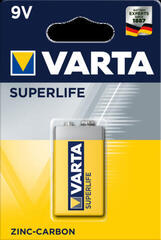
| Zinc-carbon | Whether the device manufacturer permits it | It is not an automatic replacement for every other 9V type |
| Lithium | The exact chemistry and approval in the manual | Do not confuse it with a rechargeable lithium battery |
| Rechargeable | Nominal voltage, chemistry, and a compatible charger | Do not charge it with a charger intended for a different chemistry |
Exact compatibility with the device
Before buying, open the battery compartment and read the marking near the terminals or in the manual. Check whether the device requires one 9V battery of a specific type, what polarity it uses, and whether the manufacturer permits a rechargeable version. Also check that the connector fits securely and that the battery fits without pressing against the cover, wires, or contacts.
Do not force the battery into place or modify its connector. If the device contacts are loose, corroded, or damaged, stop using the device and follow its servicing instructions. For a sensitive instrument, safety device, or medical device, follow only the documentation for the specific model; a matching shape alone is not enough.
What to check when choosing a 9V battery
- Read the exact marking on the original battery and the requirements in the manual.
- Compare the nominal voltage and chemistry.
- Check whether a disposable battery or rechargeable battery is required.
- Check the shape, orientation, and condition of both terminals.
- Make sure the device explicitly permits the selected type.
- For a rechargeable version, check compatibility between the battery and charger.
- Check that the battery casing is undamaged and its markings are legible.
- If information conflicts or is missing, postpone your choice and verify it with the device manufacturer.
Safe use and storage
Before inserting the battery, check that it is not dented, damaged, leaking, or giving off an unusual smell. Do not use, dismantle, puncture, or crush a damaged battery, and do not expose it to fire or excessive heat. The terminals of a 9V battery are close together, so protect them from being accidentally connected by a metal object such as coins, keys, or tools.
Store batteries in their original packaging or in a way that prevents their terminals from touching each other. Keep them in a dry place away from direct sunlight, heat sources, water, children, and pets. Do not mix old and new batteries or different types in one device unless the manufacturer explicitly states otherwise. If the device will not be used for a long time, follow its manual; if it recommends removing the battery, store it with the terminals protected.
If a battery leaks, avoid direct contact with its contents and follow the manufacturer’s instructions. Prevent leaked contents from coming into contact with skin and eyes, follow the manufacturer’s instructions, and seek professional help if exposure occurs. Recharge only a battery marked as rechargeable and use only a suitable charger for its specific chemistry.
Disposing of used batteries
Do not put a used 9V battery in ordinary household waste or burn it. Before transport, protect the terminals against short circuits, for example by covering each one separately with non-conductive tape, and keep the battery away from metal objects. Take it to a local collection point designated for used batteries or to an available retailer collection box. Check the acceptance conditions directly with the specific collection point, especially if the battery is damaged, swollen, or leaking.